Blog

Club Update September 2026

Eilish Maclellan and myself attended the practical session of our coxing course down in Dunstaffnage Marina. For anyone who’s rowed with other people in a boat, you’ll appreciate the importance of everyone rowing at the same time, that the boat makes some sort of progress in the right direction, and with someone ultimately being in charge… That’s the cox’s job – who knew!

Using two St Ayles wooden rowing skiffs loaned from Lorn and Appin skiff clubs, the practical session had a crew of four rowers in each boat, with a trainee cox in the stern and a trainer sitting opposite them in the bow shouting instructions, encouragement and warnings in equal measure. All the rowers there that day were to take turns in the ‘learner’ cox seat, to get trained up in the effective use of commands, good manoeuvring techniques, and other tips n’ tricks. To be honest, each of us there that day admitted to being a bit anxious about what miracles we’d be asked to make the boat do. Both Eilish and myself were attempting coxing for the first time… We were in different boats, and slightly out of earshot of each other, which was possibly a good thing. If you know either of us, you’ll know that we don’t necessarily have an issue telling people what to do, but it does help if we first have an inkling of what we’re meant to do!

Each of the crews were all ears, listening carefully to the trainers’ instructions, observing how each trainee cox managed their role of being ‘in control’. The coxs were told how to instruct their rowers to weave the boats in and out of the yachts moored in the bay, putting the coxs through figure-of-eight exercises and backing onto mooring buoys (all the while us rowers had quite the healthy workout, performing these stop-start drills until the trainers were happy). As everyone finished their session in the cox seat, they swapped places with a rower who was then put through the same coxing hurdles.

Eventually the inevitable happened and it was my turn. OK, this was it. Be calm, be loud & clear, be calm, be decisive, be calm… did I mention we were all a bit anxious?! In the end, no-one drowned and nothing was broken, it was fine and actually a lot of fun. Once I’d got the hang of the strange dual pull-strings on the boat’s rudder (very different from a wheel or a tiller), I realised just how manoeuvrable these 22ft boats actually are. And being cox, at least you’re facing forwards (not like the poor rowers who’re facing backwards, so any natural instinct you might have for port and starboard is up the spout). You wouldn’t believe how small the turning circles of these skiffs can be, especially if the rowers on port and starboard each row in different directions – that sound like it wouldn’t work but believe me it does when it’s coordinated. A turning circle smaller than that of a Lidl’s trolley IF it has four working wheels!

In the end, no injuries, no tears and no expensive yachts bashed: all in all we thought we’d had a fantastic day relatively ‘in control’ on the water. The trick now is to not forget the commands and techniques before we get back into a rowing boat… Big thanks to Liz at Lorn for arranging the course.

As our boat is still in-build, we want to hear from people who’ve worked with wood before. You don’t need to be a professional woodworker but help from semi-skilled or talented enthusiasts would be great. We meet up most Sat mornings at Kinlochmoidart. For more details, please get in touch with Eilish MacLellan or Lou Johnson.

Louise Johnson, Club Co-Chair
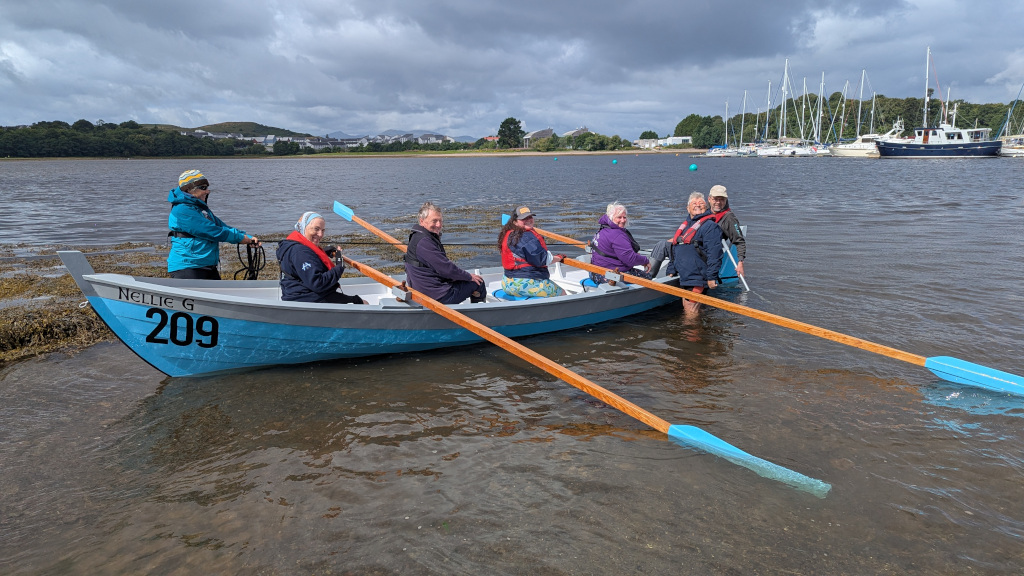
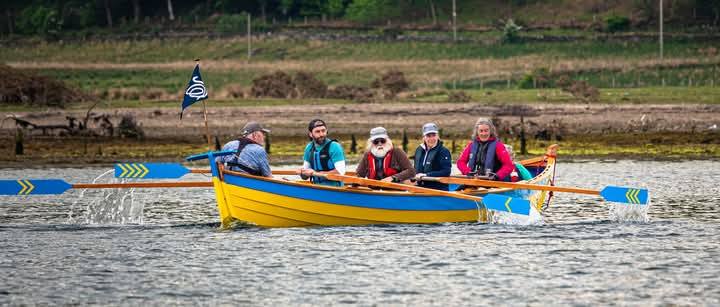
The learner cox’s in Appin’s skiff!

Skiff Build Progress August 2026

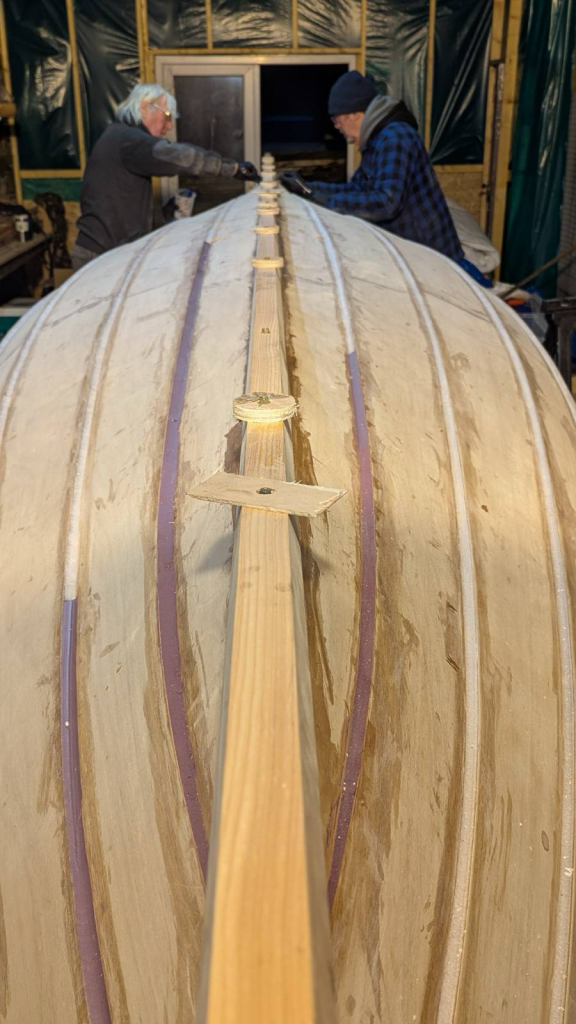
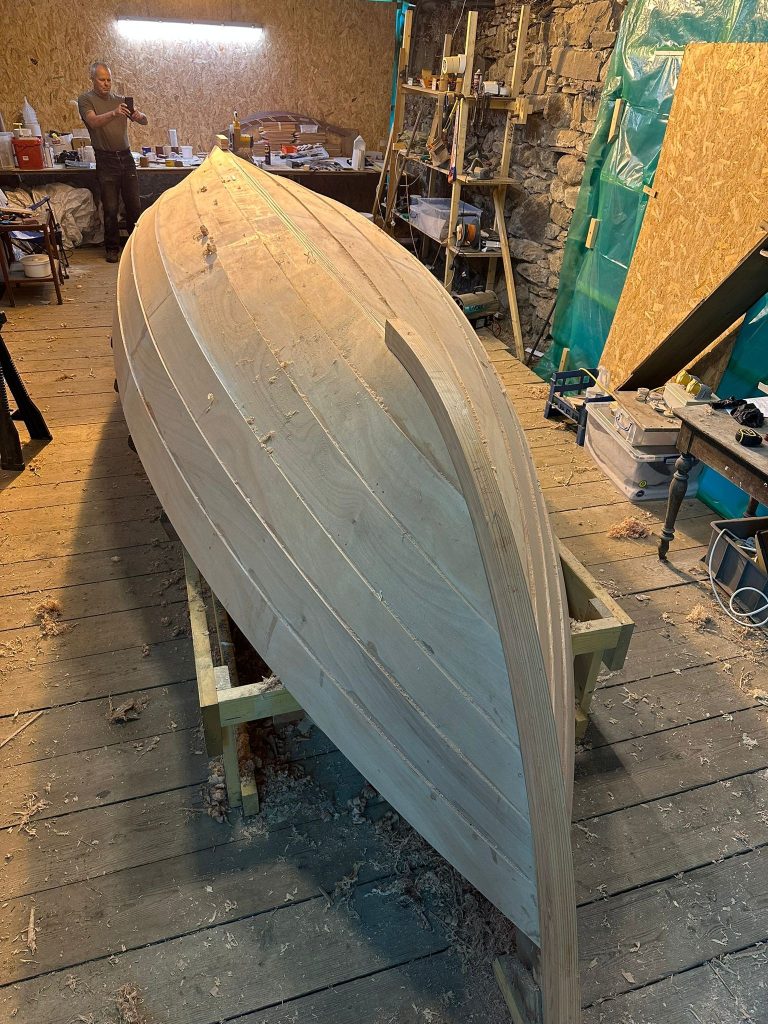
Building a coastal rowing boat, intended to be constructed by community ‘amateurs’, seemed to be a simple proposition. Progress seemed relatively easy whilst assembling the pre-cut sheets of plywood hull planking in overlapping layers forming the hull. It was a big moment for us all when we turned her over, and we could really see that she was becoming ‘a boat’! Which was when our key boat builder confided in us that we were only halfway towards completion…

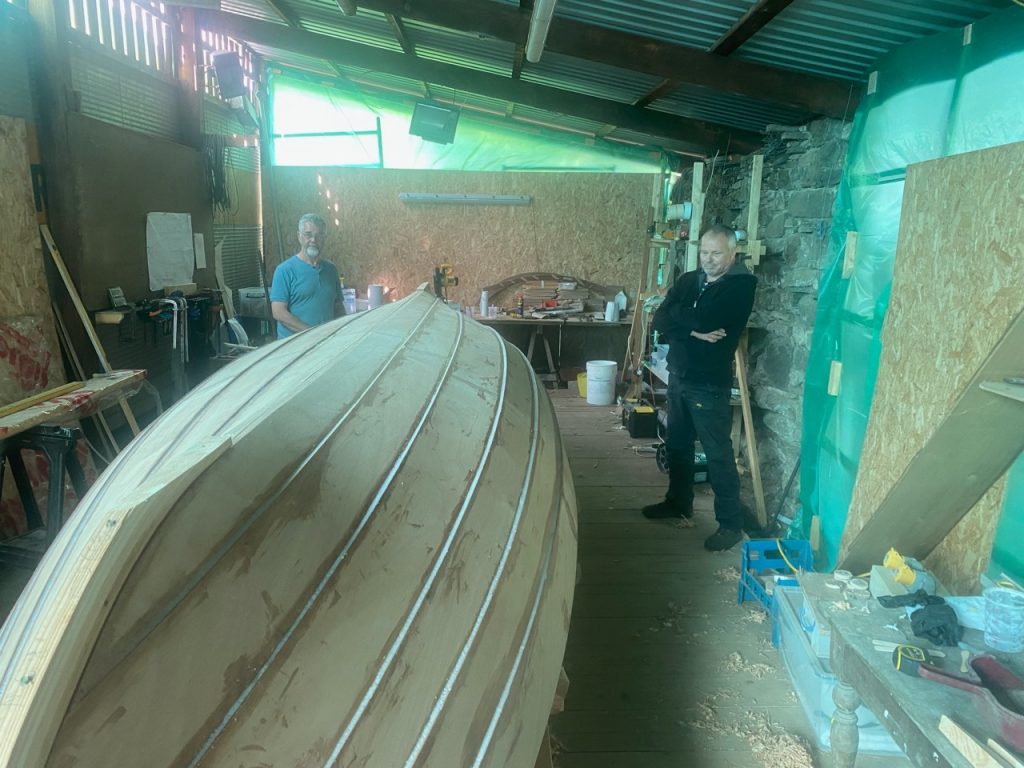
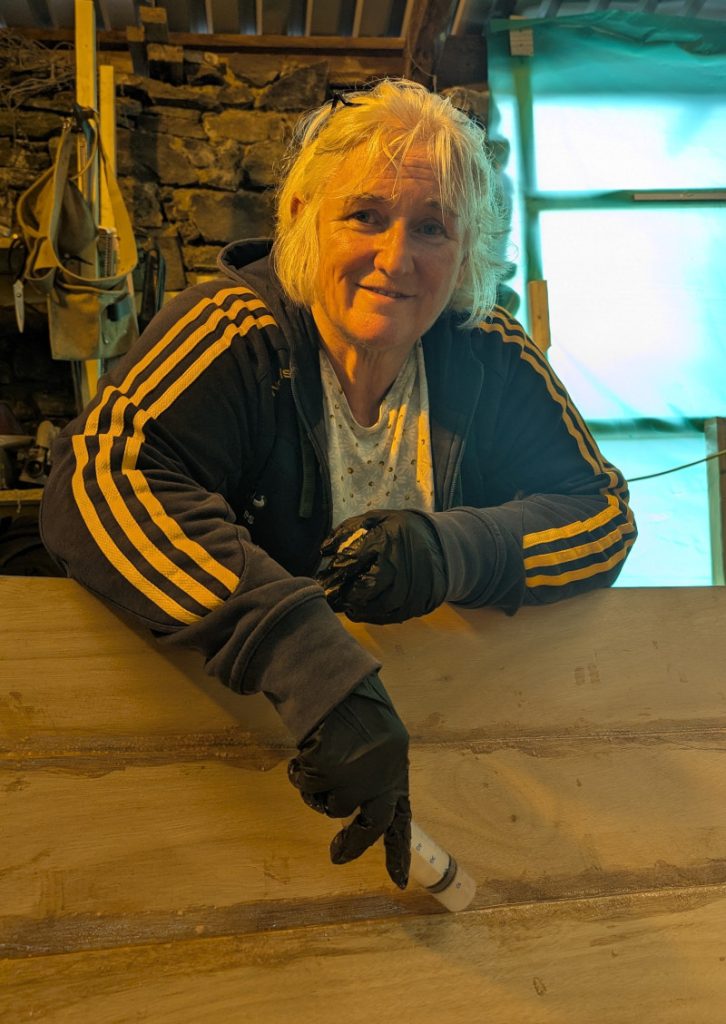
So now, suitably sobered by that news, we gear ourselves up for the long slog to fit out her interior and topsides. But the dream is still strong to see her complete, painted and pristine, ready for the water. Now that we can get to the inner plank joints we’ve been able to remove excess glue from the initial laying of planks and fill any ‘lands’ (as the plank overlap joint areas are called). This we do with a touch of epoxy to remove any chance of water ingress. Having gone to this much trouble, we don’t want any ‘dry’ joints that could become water traps and cause rot over time.

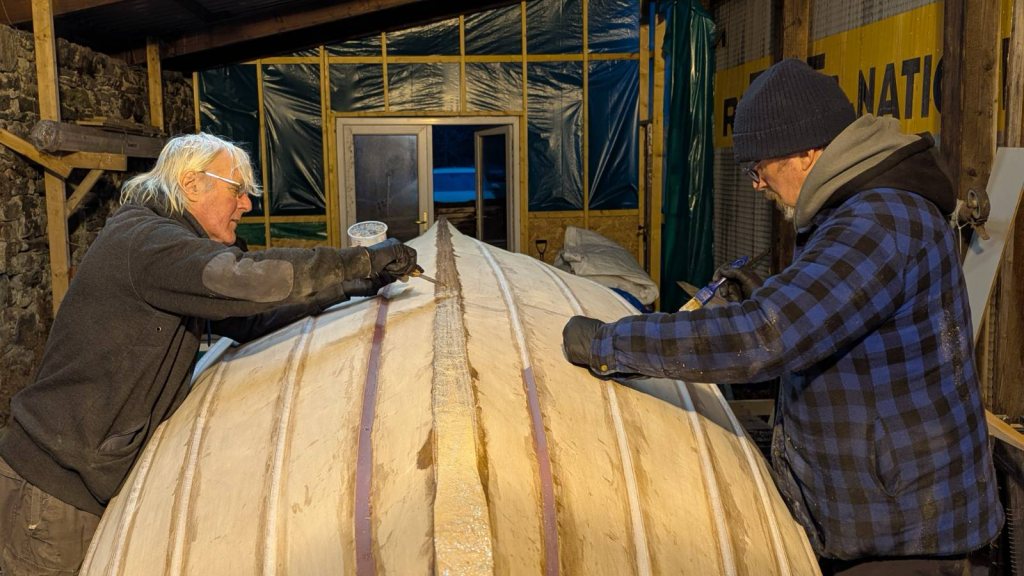
Eilish at work with the epoxy!


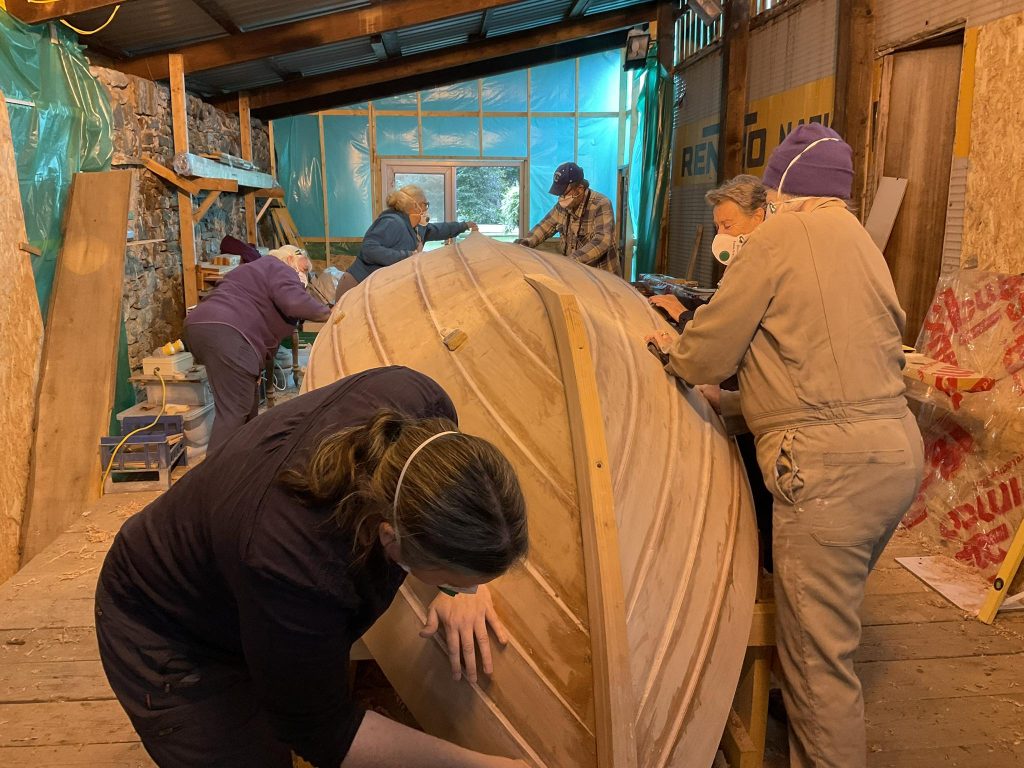
During recent Saturday build sessions, our Club Captain Eilish Maclellan has got us organised on a rota so some of us less skilled at woodwork can participate in the build. Colin has led us through handling heat guns and scrapers, removing any excess epoxy glue, leaving the lands looking neat and tidy. The epoxy is great at helping with rigidity but cumulatively does add weight – and keeping boat weight down will be highly important for when/if she’s racing!

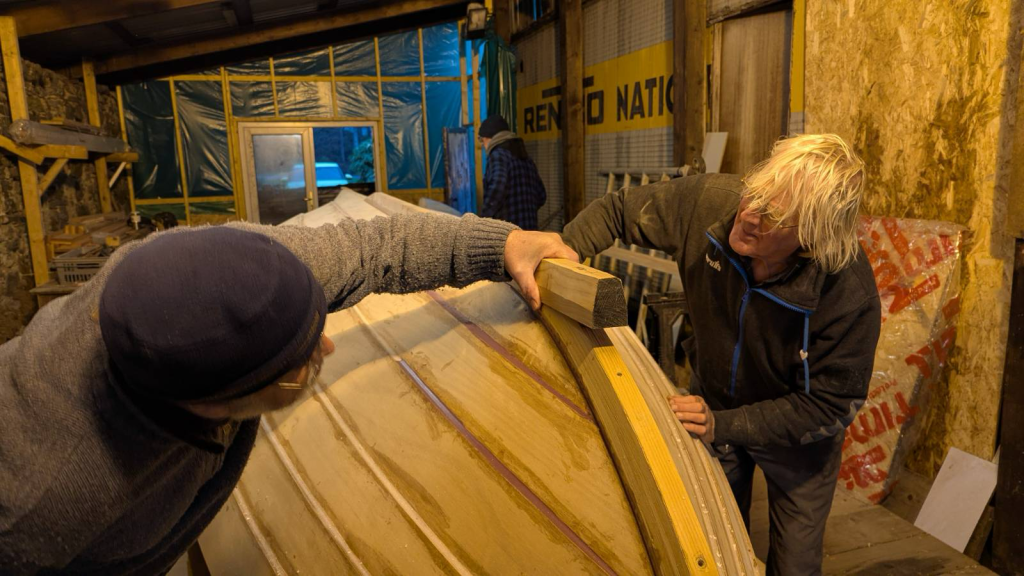
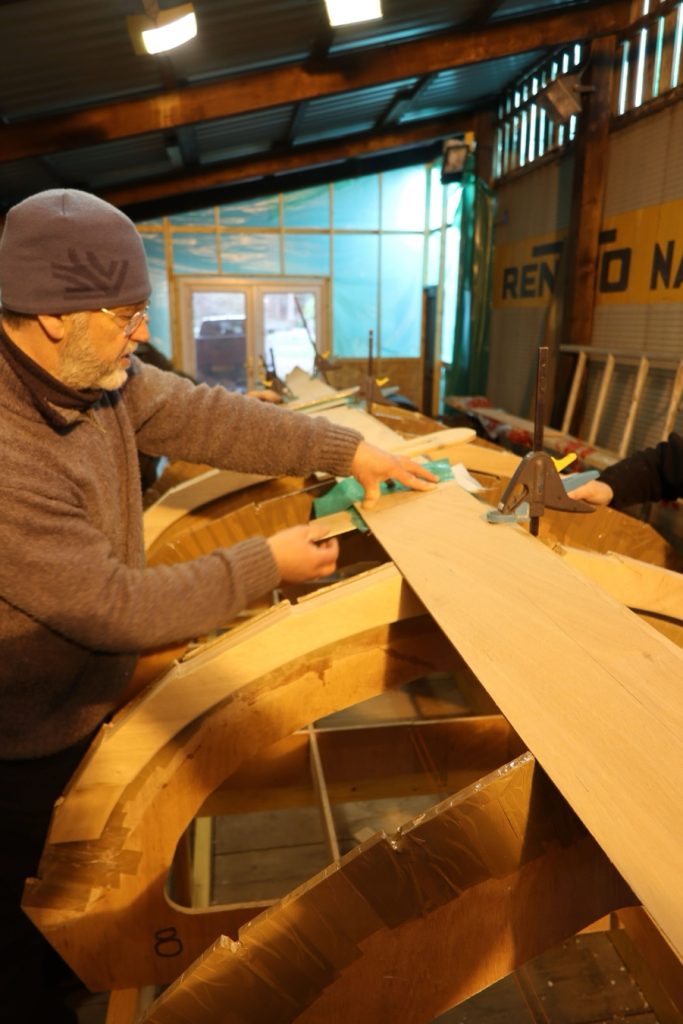
We’ve also begun making the composite timber gunwales, that will stiffen and strengthen the deck edge each side and carry the significant loads of the oars when rowing. This has entailed scarphing and gluing three lengths of timber clamped to the deck edge to help shape the gunwale. It’s a satisfying task and it’s great to be able to learn these things together.

Although the boat is being built to a St. Ayles Skiff design, we were surprised to learn the extent of leeway allowed in the construction of some parts of the working interior gear: gunwales, beams, seats/thwarts, footrests, the rudder system and tiller, and rowlocks are all areas of potential variation. Lou Johnson our Club Chair recently ran through numerous photos detailing the differences observed in features of other boats, which prompted much discussion on positives and negatives for inclusion in our own boat – excellent food for thought. We’ve rowed and inspected a few skiffs from other Clubs now and much useful knowledge has been learned, especially from those boats that tend to win races!

We’d love help from people who’ve worked with wood before… You don’t need to be a professional woodworker, but semi-skilled or talented enthusiasts would be great. We meet up most Sat mornings at Kinlochmoidart. For more details, please get in touch with our Eilish MacLellan or Lou Johnson.

Louise Johnson, Club Co-Chair
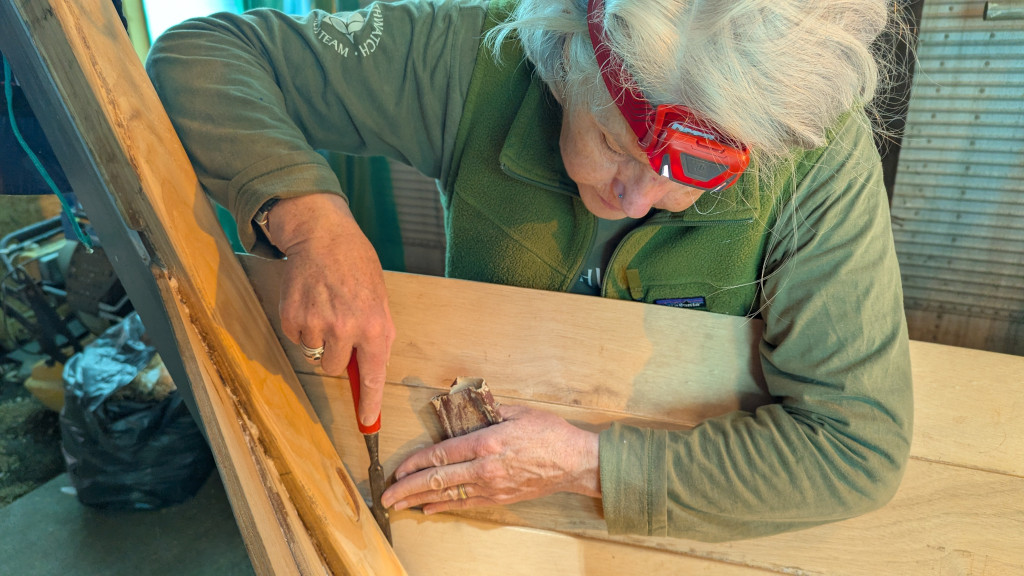
Lou chiselling off glue!

Do you like working with wood? Your local skiff club needs you!

Originally shared in the May issue of Dè Tha Dol?…

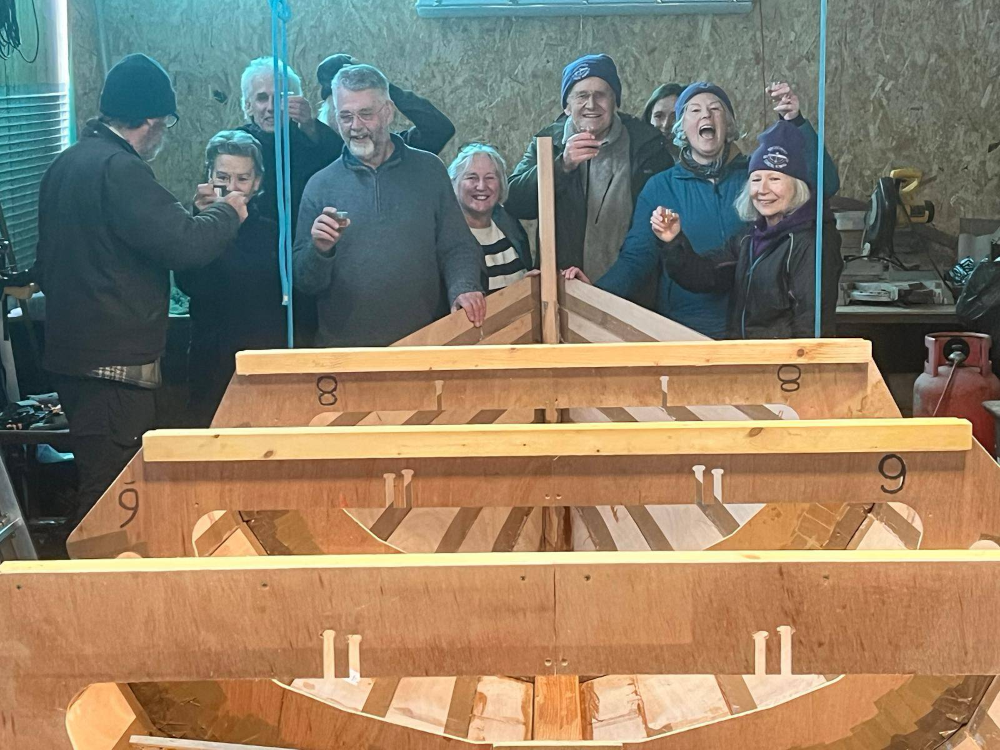
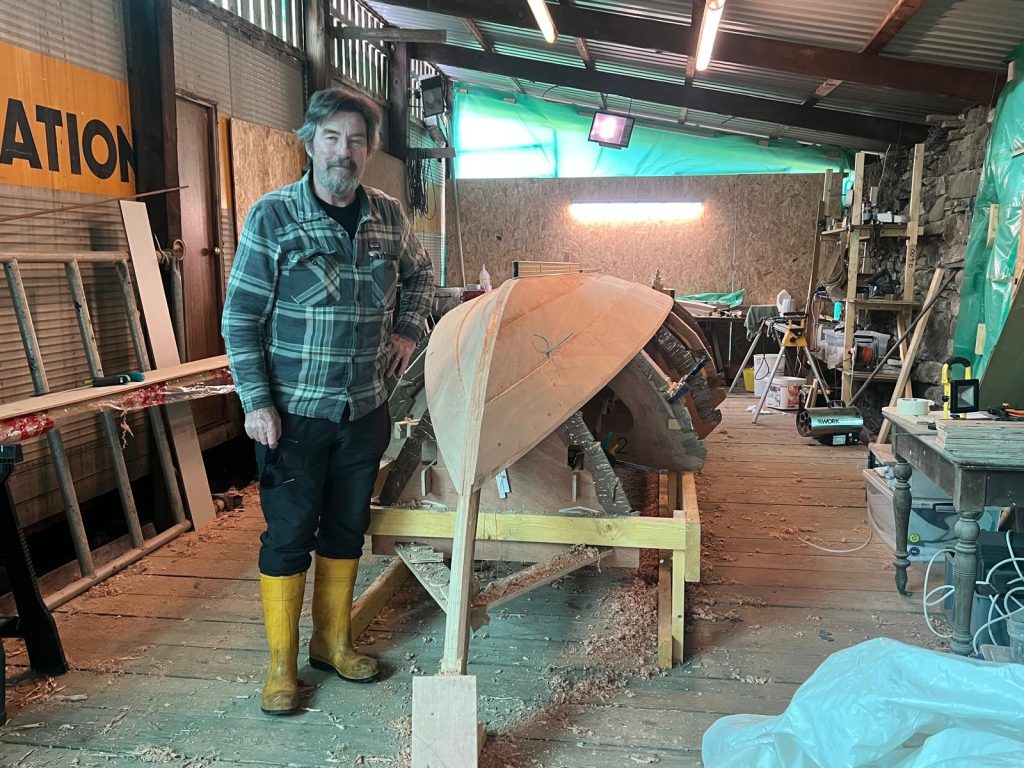
It’s been a long cold winter, but the Moidart skiff-build team haven’t been slacking. Thanks to their dedication and hard work an important milestone was reached last month: work on the outer hull was completed and on Saturday 4th April, 10 club members came together at the Kinlochmoidart shed to carefully turn over our precious skiff. Sharing a significant moment like this helps to keep the team spirit bright and positive and to celebrate this milestone, a wee dram was raised in a toast to Speireag (Sparrowhawk in Gaelic).

So now for the next steps: we’ll soon be working on fitting out the interior and topsides. Hence the call-out for people with woodworking skills to come and help over the coming months. You certainly don’t need to be a professional, but semi-skilled or talented enthusiasts would also be really useful. We need to make up and fit gunwales, the beams, the seats/thwarts, the bottom boards and floor and the footrests. We also need to make lots of dowels, the rudder system and till, the oar connections and maybe even a sculpture of a sparrowhawk to go on the bow-post!

If you’re interested in getting involved with any of this work, then please get in touch. You can contact us via our Facebook page or email: build@moidartcoastalrowing.org

There’s much to do before she’s ready for the water, but with the right skillset and some good team work, we might just be on track for launching Speireag in late summer.

Check out our website for regular blog posts, updates on build progress and training opportunities and info on how to join as a member (only £10).

Speireag has been turned!

It gives me great pleasure to confirm that the skiff build team and various other Moidart Skiffies successfully turned Speireag yesterday!

Co-ordinating the available and willing muscle power was always going to be a challenge given the relatively confined working space, however the process was aided by an ingenious pulley system that helped ensure a smooth transition thankfully, as dropping the boat during the challenging manoeuvre would have been a disaster!

This skiff team is for turning!

The time now comes for fitting out and with that a need for more skilled / semi-skilled woodworkers to complement the skiff build team and accelerate the club towards hopefully launching this season. If you think you can help or you know someone who may want to assist then please get in touch.

To the seas!

Mark

P.S. Thanks to Malcolm Fraser for the photograph!

The Skiff Build Continues, Even When Brrr!

All credit to members of our intrepid build team who have braved the less than hospitable cold weather of late, in our makeshift shed-cum-lean-to, in order to continue progress with our skiff. I am pleased to confirm that work on the keel of Speireag (Sparrowhawk) has been completed!

Might the summer of 2026 see the launch in Moidart of the first locally built skiff for generations I wonder?!

Co-op Local Community Fund


It gives me great pleasure (even at 5:30am while writing this!) to announce that Moidart Skiffies have been successful in their bid for funding from the Co-op Local Community Fund.

As per the Co-op… ‘The Local Community Fund supports projects in our members’ communities that provide access to opportunities and resources for people to thrive. Co-op Members can choose the local cause they want to support through their membership.’

So over the coming year Co-op members can support Moidart Skiffes by selecting the club as their cause and the club will receive a percentage of Co-op profits from every shop relevant members make. Co-op members can select Moidart Coastal Rowing Club as their cause here: https://www.coop.co.uk/local-causes

If you, or anyone you know shops at the Co-op and is a member please encourage them to select the club as their cause. It would be greatly appreciated and the money received will go towards essential kit for getting club members and guests out on the water safely as we ready ourselves for launching Speireag.

Moidart Produce Show – We have named the Skiff!

STOP PRESS – we have an announcement!  At the recent Moidart Produce Show Anne Widdop, co-chair of the new Moidart Coastal Rowing Club (or Moidart Skiffies as we call ourselves) gave this short speech… 

Anne dodging the showers!

‘This is a proud moment for the club, and hopefully for Moidart and surrounding areas too, as I want to reveal the name of our brand new community skiff. After months of stretching planks, glueing and inhaling far too much epoxy, our skiff is nearing completion. It will soon be ready to fly across the water. 

Now, if you’re wondering why on earth the fuss about one wooden boat, it’s because – boats are in the blood of Moidart. For centuries, this place relied on them. From the sturdy birlinns of the Clanranalds to the launches that carried mail, passengers, and gossip up Loch Shiel and around the coast. Wooden boats connected people, brought supplies, and no doubt occasionally smuggled the odd thing or two, or so I’ve heard…

But somewhere along the way, the roads and cars came, and the boat building stopped. Until now. Moidart Skiffies are the first folk in living memory to build a wooden boat here in Moidart – and we’ve done it together, plank by plank, with much scratching of heads as we have figured how to do it, and more sanding than any of us ever thought humanly possible.

And what is the Moidart Coastal Rowing Club about? Well, it’s not just about rowing – though that does come in handy! It’s about bringing people together. It’s about giving young and old the chance to be part of something, to learn new skills, to get out on the water, and, most importantly, to laugh together when we row in perfect circles instead of in a straight line.

Now, building a boat is a bit like keeping a Highland cow. They’re beautiful, but they do eat money. So, if you are keen to see the Skiff club flourish, please think about sponsoring the boat, joining the club, or making a donation.

Every penny is put towards building the club, and we still have a lot to do. And if you join the club, you won’t just get a chance to row – you’ll get fitness, fun, friendship, and possibly forearms like Popeye.

So today, with pride and with a sense of history, I reveal the name of the boat as Speireag. I hope you will see her flying across the local waters with grace, with strength, and – if the cox steers us straight – maybe even in the right direction. Flying being a particularly apt description given Speireag means Sparrowhawk in Gaelic.

Community led clubs like the Moidart Skiffies matter. They bring communities together, and they make sure that in fifty years’ time, when people talk about the last wooden boat built in Moidart, they’ll say: ‘Ah yes – that was Speireag – built by hand by local volunteers.’ Finally, I’d like to say a huge thanks to Nino for letting us commandeer a shed to build the boat in. It’s been invaluable to help us get going.

Thank you, and let’s get rowing!

Kind Regards

Anne Widdop

Our new club mascot?!

Skiff Build Update – August 2025

It has been a busy time for the skiff build team of late however I am pleased to report great progress continues to be made. Towards the end of July the final plank was laid before the outer stem / sternpost were carefully planed prior to being glued into place.

‘Planely’ the best skiff around!

This was then followed by work to apply epoxy filleting to both sides of the hull as well as attaching the bow and stern posts. Hopefully it won’t be long before we see that bow slicing through the waves!

Like proud parents looking on!

In August another milestone was reached as a busy team of volunteers helped with the sanding in preparation for the keel being attached, before faring, more sanding and finally painting. It won’t be long it seems before we will be having our boat turning party!

Smooth operators!

Well done to all involved in the progress made so far. After the boat turning party, I guess we can look forward to the boat completion party, followed by the boat launching party!

SCRA Cox Training Course

A report courtesy of Jean Langhorne.

As Scotland’s newest coastal rowing club, we were very chuffed to have a chance to take part in the Scottish Coastal Rowing Association (SCRA) cox training course at Ardfern recently.

The weekend was hosted by Craignish Boat Club and the two SCRA cox trainers were Liz Furrie from Broughty Ferry CR and Anne Purcell from Queensferry CR.

In attendance over the two day course were twenty trainee coxswains from four clubs: Craignish, Achnamara, Lorn and the two of us from Moidart. We were the keen rookies; the only ones without a club boat (yet!) and the least experienced rowers. However we were made to feel very welcome and really enjoyed the weekend. Saturday afternoon was classroom theory in the village hall (with plenty of cake and tea) and Sunday morning was coxing practice on the water in two beautiful skiffs: Daisy Bell and the Craignish Comet. The Saturday classroom session began with the skills and responsibilities of the cox, and what important considerations are involved in making the crucial decision of whether or not to launch the boat. We also discussed the role of the responsible person, lifejackets, potential hazards, the essentials of the boat, the boat checklist, the VHF and the most important element – the crew!

The weather on Sunday was warm and dry with a gentle breeze; ideal for practising the skills of boat handling, manoeuvring in tight spaces, buoy turns and backing onto a buoy, hard stops, spins, pontoon arrival and departure and oar deployment. 

A very informative and useful weekend: much to learn and practise, lots to think about in terms of what structures and protocols to put in place for our own club.

Everyone we met from the other three clubs were all very friendly and enthusiastic about all things skiff and rowing-related.

It was a real pleasure to have a chance to row these two beautiful skiffs: Achnamara’s “Daisy Bell and the “Craignish Comet”.

Jean giving it some!
Peter the budding cox!


We’re really looking forward to having a chance to put these new rowing and coxing skills to good use very soon. While we’re waiting for our own Moidart skiff to be finished, we’re taking opportunities to get out on the water and get some rowing practice with Lochaber Coastal Rowing Club at Corpach, near Fort William.

Skiff Build Update – April 2025

An update on the build process courtesy of Andrew and Colin.

Building a boat in a freezing cold shed in the winter, in Moidart in the Highlands is a challenge; we have only a few hours a week and (for my part) it can involve a 1,000-mile road trip to and from Bath to keep things moving along. There are times where we turn up at the shed and it’s cold and wet and we wonder what on earth we have let ourselves in for.

And then… the lights come on, the big heater roars into life, the banter starts, and I realise that I am indeed very lucky to be working alongside an amazing group of highly talented, motivated new friends. I swore I would never build another boat again but boy am I glad I said yes to this project. I now feel ‘rooted’ in my new home here and I’m excited to be involved.

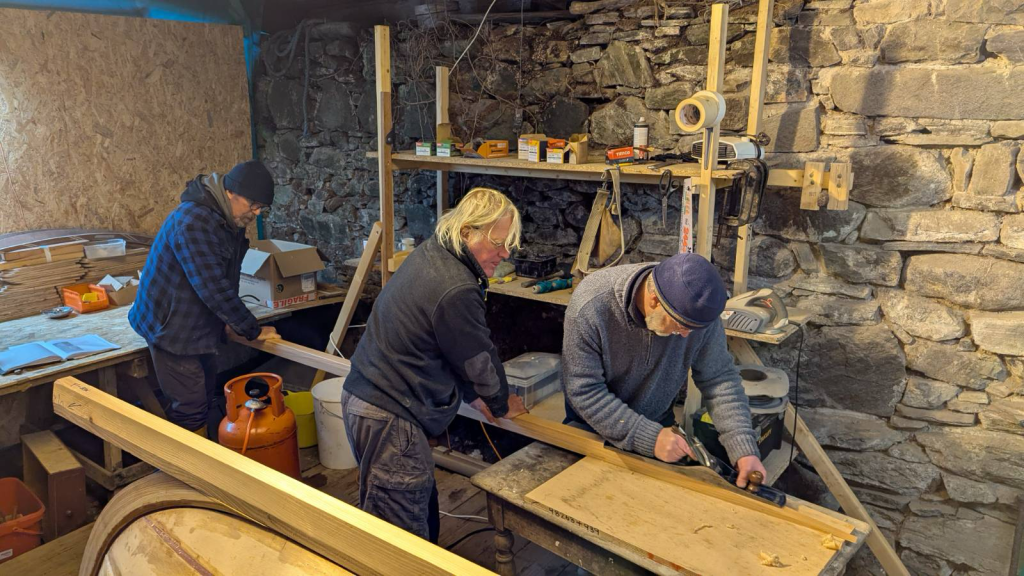
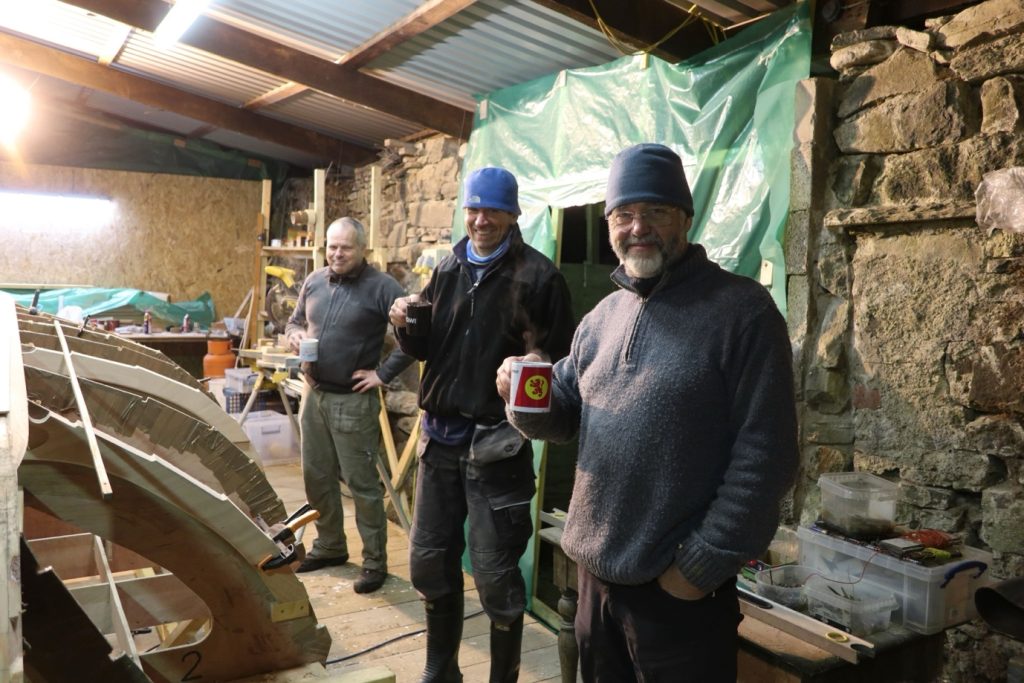
Three of the team having a well earned tea break!

Many of you will have seen images of the aprons and stems being laminated and fitted to the build jig (these are the inner and outer curved bow and stern timbers).

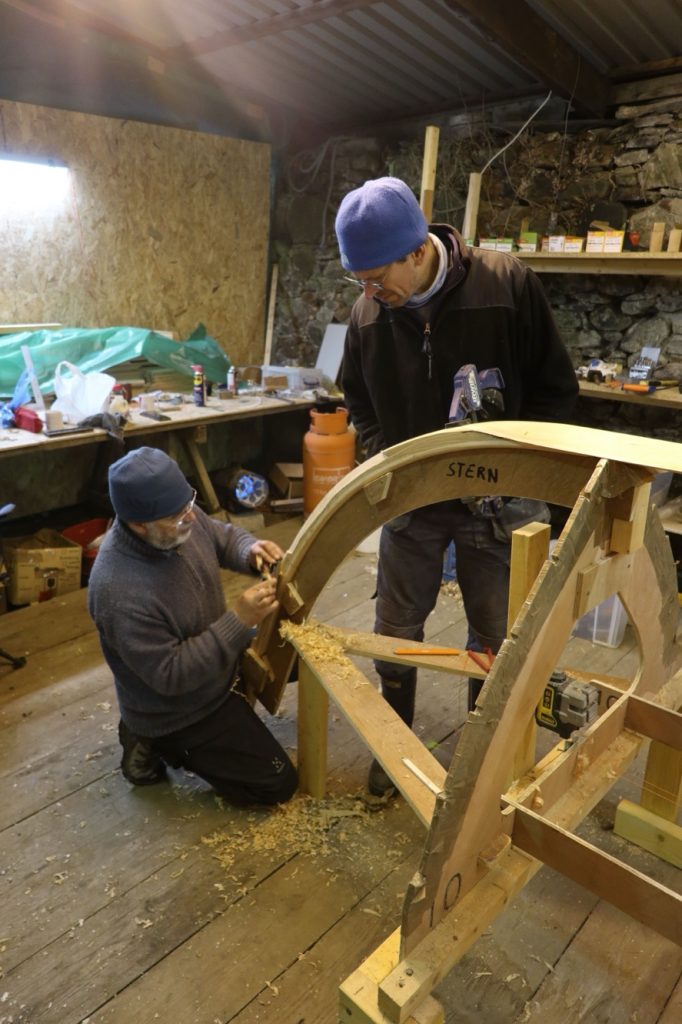
The stern post being faired.

Since then, the Keelson (inner keel) has been scarfed (joined) and glued to the aprons and carefully shaped to take the planking (each plank joins the stem/stern at a slightly different compound angle and the structural members need to be shaped to achieve a good faying surface (the surfaces where the parts meet and are glued are called faying surfaces).

The first plank being glued in place.

The first two planks to be hung are the Garboards, these lie along the keel and are a key structural part of the hull. The garboards are now in place and look fabulous – they are always tricky to fit and the process often involves a lot of swearing 😀 since they are almost vertical at either end where they join the stem / stern but near horizontal amidships where there is little deadrise (V shape in the hull).

She’s looking good so far!

The next four planks (two planks either side) can be tricky too, but these are now glued in place and the next two are prepared, Gains and Lands have been planed (gains are where the planks taper into each other as they enter the stem and stern), the overlap gradually disappears and gives a really stylish look to the hull if done well. Lands are where each plank ‘lands’ on the next and form an overlap to keep the water out. So, when these planks (eight so far) are in place, the hull will be well over half-planked. I think she’d float as she is… albeit with only four inches of freeboard (freeboard being the distance from the waterline to the Gunwale – edge of the boat where the oars rest).

Apologies for all the boatbuilding terminology, but it’s an important part of the romance and mystique of this exciting nautical adventure! 😀