Skiff Build Progress August 2026
Building a coastal rowing boat, intended to be constructed by community ‘amateurs’, seemed to be a simple proposition. Progress seemed relatively easy whilst assembling the pre-cut sheets of plywood hull planking in overlapping layers forming the hull. It was a big moment for us all when we turned her over, and we could really see that she was becoming ‘a boat’! Which was when our key boat builder confided in us that we were only halfway towards completion…
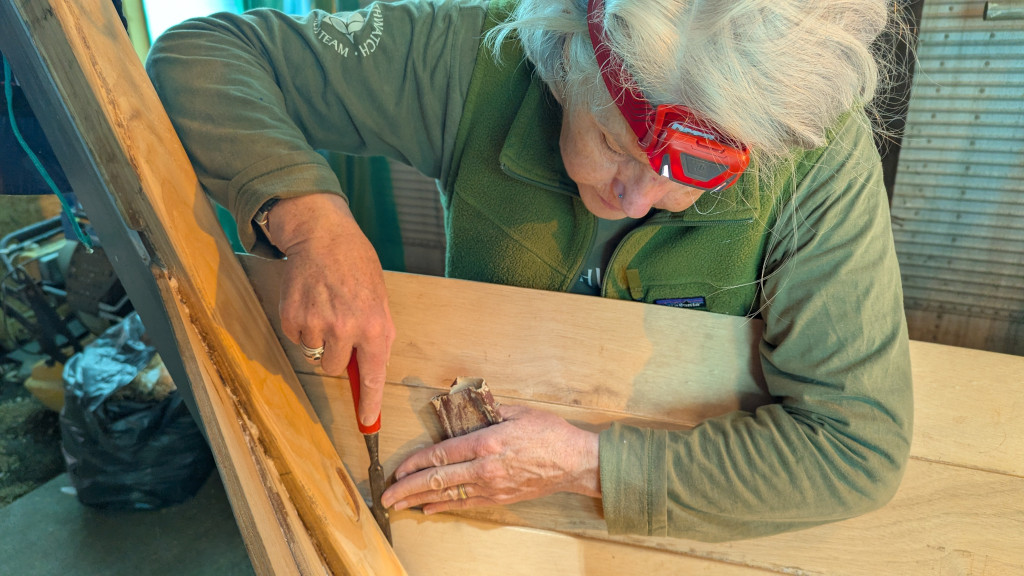
So now, suitably sobered by that news, we gear ourselves up for the long slog to fit out her interior and topsides. But the dream is still strong to see her complete, painted and pristine, ready for the water. Now that we can get to the inner plank joints we’ve been able to remove excess glue from the initial laying of planks and fill any ‘lands’ (as the plank overlap joint areas are called). This we do with a touch of epoxy to remove any chance of water ingress. Having gone to this much trouble, we don’t want any ‘dry’ joints that could become water traps and cause rot over time.
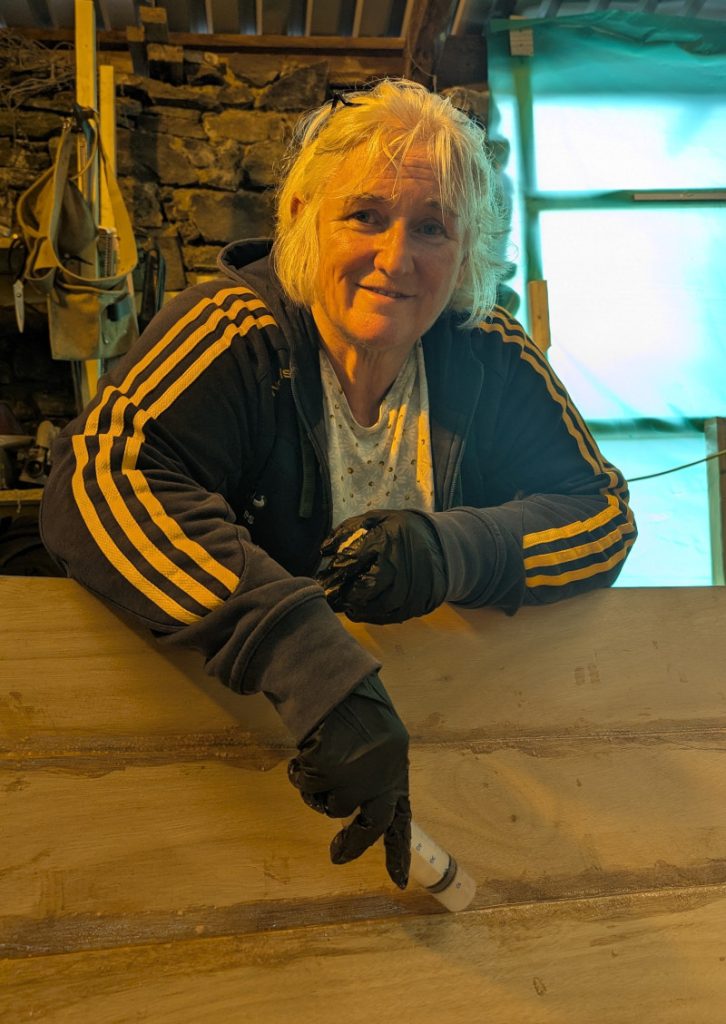
During recent Saturday build sessions, our Club Captain Eilish Maclellan has got us organised on a rota so some of us less skilled at woodwork can participate in the build. Colin has led us through handling heat guns and scrapers, removing any excess epoxy glue, leaving the lands looking neat and tidy. The epoxy is great at helping with rigidity but cumulatively does add weight – and keeping boat weight down will be highly important for when/if she’s racing!
We’ve also begun making the composite timber gunwales, that will stiffen and strengthen the deck edge each side and carry the significant loads of the oars when rowing. This has entailed scarphing and gluing three lengths of timber clamped to the deck edge to help shape the gunwale. It’s a satisfying task and it’s great to be able to learn these things together.
Although the boat is being built to a St. Ayles Skiff design, we were surprised to learn the extent of leeway allowed in the construction of some parts of the working interior gear: gunwales, beams, seats/thwarts, footrests, the rudder system and tiller, and rowlocks are all areas of potential variation. Lou Johnson our Club Chair recently ran through numerous photos detailing the differences observed in features of other boats, which prompted much discussion on positives and negatives for inclusion in our own boat – excellent food for thought. We’ve rowed and inspected a few skiffs from other Clubs now and much useful knowledge has been learned, especially from those boats that tend to win races!
We’d love help from people who’ve worked with wood before… You don’t need to be a professional woodworker, but semi-skilled or talented enthusiasts would be great. We meet up most Sat mornings at Kinlochmoidart. For more details, please get in touch with our Eilish MacLellan or Lou Johnson.
Louise Johnson, Club Co-Chair